
Before I speak about politics, I want to begin where many of our political journeys truly start: with our mothers.
My mother is not political in the party sense. But she has one story she has told hundreds of times, with enormous pride. When I was five years old, I used to take our family phone book, sit on the floor, and call friends and relatives to deliver what I believed were “political updates.” According to her, I spoke with great seriousness about what Hosni Mubarak had done that week, and what I thought Bill Clinton should have done differently. I have no memory of this but judging from how many times she has repeated it, she clearly does.
My father was the political one. He came from Syria, worked as a sailor, migrated through Italy, and eventually settled in Gothenburg in the late sixties. He kept working on boats, and during a trip to Khartoum in Sudan, he visited a friend’s company where my mother worked as a secretary. The spark was immediate. She followed him to Sweden in 1980. Seven years later, I arrived.
My mother built her life in Sweden as a Black Muslim woman wearing hijab, working as an assistant nurse for forty years. When my father passed away, she became a widow with four children – navigating grief, work, and a society where racism and prejudice were part of everyday life. Her story shaped me long before I understood the language of politics.
For a long time, when I looked at Swedish politics, I could not see myself. But even more painfully: I could not see my mother. A woman who carried Sweden on her shoulders, who cared for the sick, who survived loss and discrimination, who held a family together. Who represented her? Who understood her story? That question stayed with me.
Early activism
When I was sixteen, that question turned into action. As a teenager, I loved playing basketball. But through basketball, I realised just how segregated Gothenburg really was. There was no central public basketball court in the city where children and young people from different neighbourhoods could come together and play. Opportunities were divided by geography, class, and race.
So, I created a local initiative demanding a public basketball court. We collected signatures, organised meetings, contacted journalists, and kept showing up in front of the decision-makers, and after just four months of pressure, the city finally agreed, and the basketball court was built – open, free, and accessible to everyone.
And more than twenty years later, it is still there. You can go there today and see children, teenagers, and adults from across the city playing side by side. In a time when gentrification pushes marginalised communities further away, when free public spaces shrink, that court remains a living reminder: when marginalised young people demand space, they are not asking for charity – they are designing democracy.
That experience taught me that inequality is not abstract. It is concrete. It is physical. It is measured in who has space – and who is pushed out of it. So, we talk about equality, but we do not live it. And once you see that contradiction, you cannot unsee it.
Politics and feminism
This contradiction is the lens through which I entered politics. And it is the lens I bring to this stage today. Why feminist political parties emerge. How we tried to build one from the inside. What it means to lead such a project. And what all of this tells us about the future of democracy.
Feminist parties do not emerge because things are going well. They emerge because the political landscape has failed. Failed to protect women. Failed to protect racialised communities. Failed to confront violence. Failed to create institutions where people like my mother – and people like me – are fully recognised.
Traditional parties often treat gender equality as a decorative commitment. A slogan in a programme. A paragraph added at the end. But rarely as a principle that redistributes power.
Feminist political parties are structural interventions. They insist that equality is not a side issue, but the organising logic. And once you take that step, you do not simply create a party – you create a different blueprint for democracy.
Inside the party, we had to practise the politics we preached. You cannot demand intersectional justice in society while reproducing hierarchy and silence internally. So, we experimented. Co-leadership models. Transparent decision-making. Consent-based processes. Speaking-order protocols designed to lift voices usually pushed aside. Safety officers. Anti-racism guidelines. Feminist protocols that made care and accountability part of everyday governance.
These protocols were not symbolic – they were the operating system. And like any operating system, they revealed the fractures inside us. Sometimes they created deep democratic participation. Sometimes they exposed how patriarchy lives inside all of us, even in feminist spaces. But conflict inside feminist movements is not failure. It is information. It shows where structures need strengthening. Where care needs reinforcing. Where clarity must replace assumption.
This is not only a lesson for feminist parties. It is a lesson for all political organisations. Democracy cannot renew itself if the internal cultures of politics remain untouched by feminist analysis.
When I entered party leadership, I carried with me my father’s journey, my mother’s resilience, my neighbourhood, my classroom, my own experience of belonging and not belonging. In traditional politics, these identities are treated as “personal stories.” In feminist politics, they are analytical tools.
Leadership in a feminist party is different. You are never just a spokesperson. You become a symbol – for representation, for conflict, for possibility, for every story that has been missing. Visibility becomes both a resource and a risk.
Political violence: the cost is real
The cost is real. Daily harassment and racialised threats. Media frames that focus more on your tone and appearance than your structural critique. Institutions that welcome you symbolically but resist you structurally. I learned quickly that feminist politics requires an infrastructure of protection – digital, emotional, organisational. Because the people who carry the deepest insights into injustice are also the most vulnerable to political violence.
And these are not abstract risks. Long before online hate became a recognised democratic threat, some of us were already living with the physical consequences of being visible. In my case, that meant a man knocking on my door and attempting to stab me. It meant faeces and hate letters pushed through my mailbox. It meant goods and services ordered in my name as a form of harassment. These experiences were not ‘incidents’ – they were messages about whose voice should remain silent in the public sphere.
And I was not alone. In Sweden, even women with significant political power have faced similar violence. Former party leader Annie Lööf survived a planned assassination attempt. Anna-Karin Hatt stepped down from leadership after only a few months, citing unsustainable levels of threats and harassment. These stories illustrate something essential: political violence is not only directed at marginalised women. It targets any woman who gains influence. But when you add racialisation, religion, migration background or LGBTQIA identity, the danger intensifies – and the silence around it grows.
When I stepped down as party leader, it was not an end to my political commitment. It was a strategic shift. A recognition that feminist transformation must outlast any one person, one name, one election cycle.
Feminist politics begin in everyday life
As some of you might know, I work as a teacher in Sweden. And in the classroom, you see something that policymakers often miss inequality starts early. Children understand hierarchy long before they understand ideology. They know who is encouraged, who is doubted, whose languages are valued, whose families are mistrusted. This is where feminist politics truly begins – not in manifestos, but in everyday life. Democracy is not just a system; it is a relationship between people and institutions.
My work in anti-racist and decolonial spaces confirmed this. You cannot build feminist politics without confronting racism and transphobia, migration policy, colonial history, and the uneven geography of belonging. These structures overlap – and so must our political solutions.
Across Europe, feminist parties are often dismissed as “niche,” until crisis hits. Then suddenly, feminist analysis becomes essential. The Netherlands, Sweden, Moldova, Spain – we are all facing the same question: how do we build political cultures that do not simply include women, non-binary and transgender people, but transform because of them.
Let me return to the beginning – to my mother’s story of the five-year-old calling relatives about Mubarak and Clinton. She always laughs when she tells it. But beneath the humour lies something serious: even as a child, I was trying to understand power and hold it accountable.
Today, somewhere in Europe, another child is doing the same. Wondering why their mother is treated differently. Why their neighbourhood is policed more heavily. Why their family is not represented in the stories politics tells about the nation.
One day, that young person will “call the system.” The question for all of us is: what will answer them? A democracy built on symbolic inclusion. Or a democracy designed through feminist principles – care, justice, accountability, and shared power?
Feminist political parties are not perfect. But they are laboratories for the democracy we need next. They are the places where the stories of mothers, children, migrants, workers and racialised communities – all those left outside the political imagination – can finally shape political design.
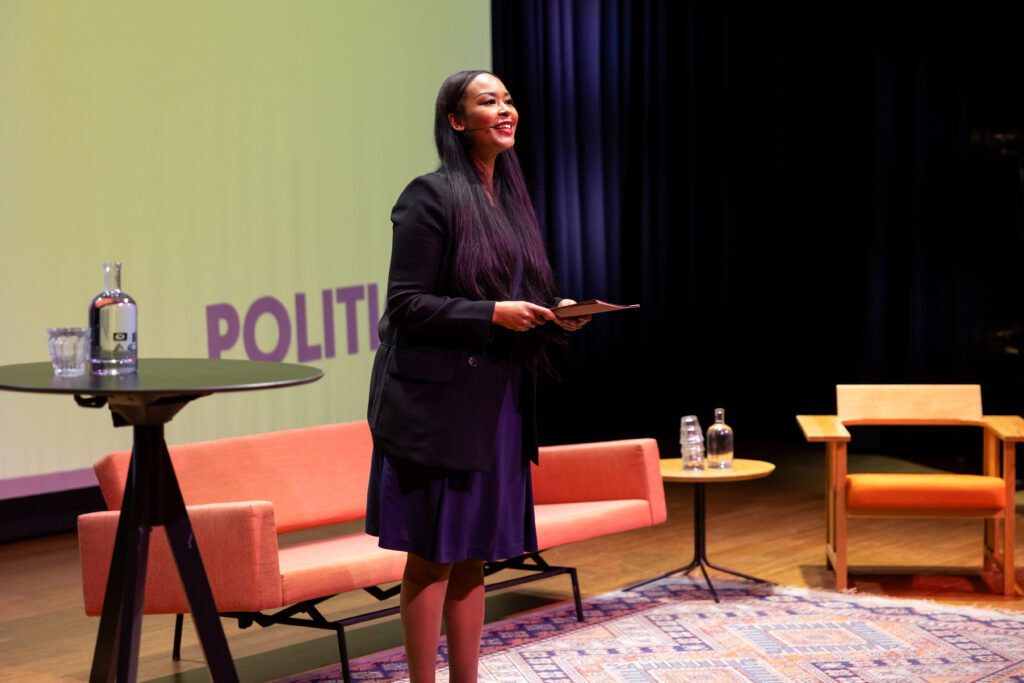
Teysir Subhi delivered this keynote during the Politica conference: ‘Van Buitenland tot Binnenhof’ on Friday 28 of November.
Teysir Subhi is een Zweedse pedagoog en voormalig partijleider van Feministiskt initiativ. Ze speelde een belangrijke rol in het ontwikkelen van het intersectioneel feministisch discours in Zweden en het vergroten van het begrip over hoe gender, ras, klasse en andere machtsstructuren samenhangen. Als keynote spreker deelde ze haar ervaringen met intersectioneel feminisme en antiracistische belangenbehartiging, met focus op het versterken van democratische participatie, vertegenwoordiging en veiligheid in de politiek.